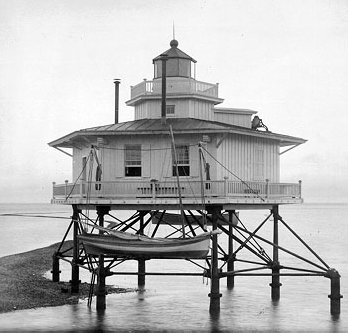
Bygone Beacons: The James River Lighthouses and their Lightkeepers.
Sep
20
2:00 PM14:00

Bygone Beacons: The James River Lighthouses and their Lightkeepers.

  • Benn's United Methodist Church (map)
  • Google Calendar ICS

Imagine the anguish of receiving this telegram, “Your child Gertrude burned yesterday. No chance of recovery.” That was the telegram received by John Filmore Hudgins, Assistant Lightkeeper at Nansemond River Lighthouse in January 1896. When he received it, the telegram was at least a couple of days old, having traveled from its origin in Port Haywood Virginia, near Mobjack Bay, to West Point, then Norfolk and finally via Lighthouse tender to him on station. It would be at least another day before he could get home to be with his family. The good news is that Ellen Gertrude survived her burns and lived to be 96.

We uncovered many stories about the Lightkeepers serving in the lower Chesapeake Bay and North Carolina sounds. They lived on remote stations and were on duty 24 hours a day with only occasional chances to be home. They were dedicated men and women, living in often harsh conditions always dutifully maintaining their light while attending to their unending chores.

The James River lighthouses played an important role in our county’s history, first exhibiting their lights in 1855 in response to increasing steamship traffic. They continued in service until changing technology and declining river commerce forced their demise starting in the 1930’s. Their design was unique at the time, using a newly invented screw pile foundation supporting a cottage style residence and cupola to house the light.

The James River was an important route for commerce by 1860, making possible 15 to 20 steamship landings per day at Richmond. Our presentation will include details about the James River lighthouses, their design, where they were located and why those sites were chosen. We will talk about their vital importance during the golden age of steamship travel.

We will share insights of the Lightkeepers lives, gained from research of their records and correspondence, exhibiting their dedication, their daily routines and their many fascinating stories. We will also present a demonstration of lighthouse lamps and lenses.

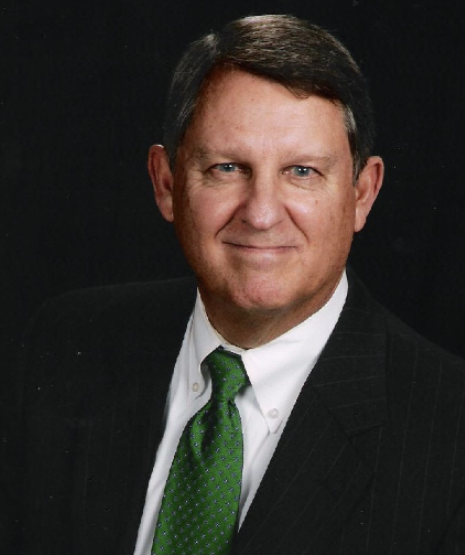
Larry Saint is a retired registered investment advisor and a licensed life insurance specialist working with Walls Insurance. who has a love of maritime history, boats and boat modeling. He is a member of several civic organizations, including the CE&H Ruritans, Smithfield Rotary and SmithfieldVAEvents.

He is a member of Suffolk River Heritage, a nonprofit group and publisher of local history books. He is coauthor of their most recent book, Screwpiles: The Forgotten Lighthouses. This was a 4-year project involving extensive research, interviews and writing about the lighthouses of the Chesapeake Bay, James River and North Carolina Sounds. The book stemmed from research Larry conducted while creating a model of the Nansemond River Lighthouse. He used original plans from the National Archives and he spent many hours there gathering lighthouse records, correspondence, plans and documents.

He and coauthor Karla Smith have given talks about their research at museums and various organizations. Their books were selected for the 2019 Virginia Humanity’s Book Fare in Charlottesville and the Williamsburg Book Fare.

Larry and Karla and Suffolk River Heritage are now working on digitizing all the records they have gathered so they can be housed online and accessible to anyone interested in the lighthouses and lightkeepers. Larry and Nancy Saint have been married 50 years and have a daughter living in Richmond.

Karla Smith is a lover of history, maps, charts, and vintage photographs.  She is a retired educator, having taught history, geography and environmental science for more than 40 years. Karla founded Suffolk River Heritage in 2006 with the purpose of gathering local history and stories about the people of Crittenden, Eclipse and Hobson, Virginia.  The result was the new organization’s first book; The River Binds Us.  

Two more cultural history books followed: Peninsula In Passage and Truckin’ on the Western Branch. Karla’s love of the water, boats and navigation led her to collaborate with Larry Saint and others to produce a fourth book, Screwpiles: The Forgotten Lighthouses.   That book highlights the history, stories, maps, and documents of the lighthouses of the James River and lower Chesapeake Bay.

“Sailing voyages on the Chesapeake Bay have taken me north to Baltimore and back, often through the night.  The lighthouses and buoys were our guide as my shipmates, and I used a compass, lead line, and log line along with NOAA Charts to navigate.   We followed the string of lighthouses from Thimble Shoals to Thomas Point matching them “dot to dot” on our chart. We verified our location with a handheld GPS but still relied on NOAA charts and the steadfast lighthouses to mark the way grateful for the blinking beacons in the distance.”
View Event →

Smithfield Juneteenth Celebration - Historical Perspective of Civil War Contrabands
Jun
19
1:00 PM13:00

Smithfield Juneteenth Celebration - Historical Perspective of Civil War Contrabands

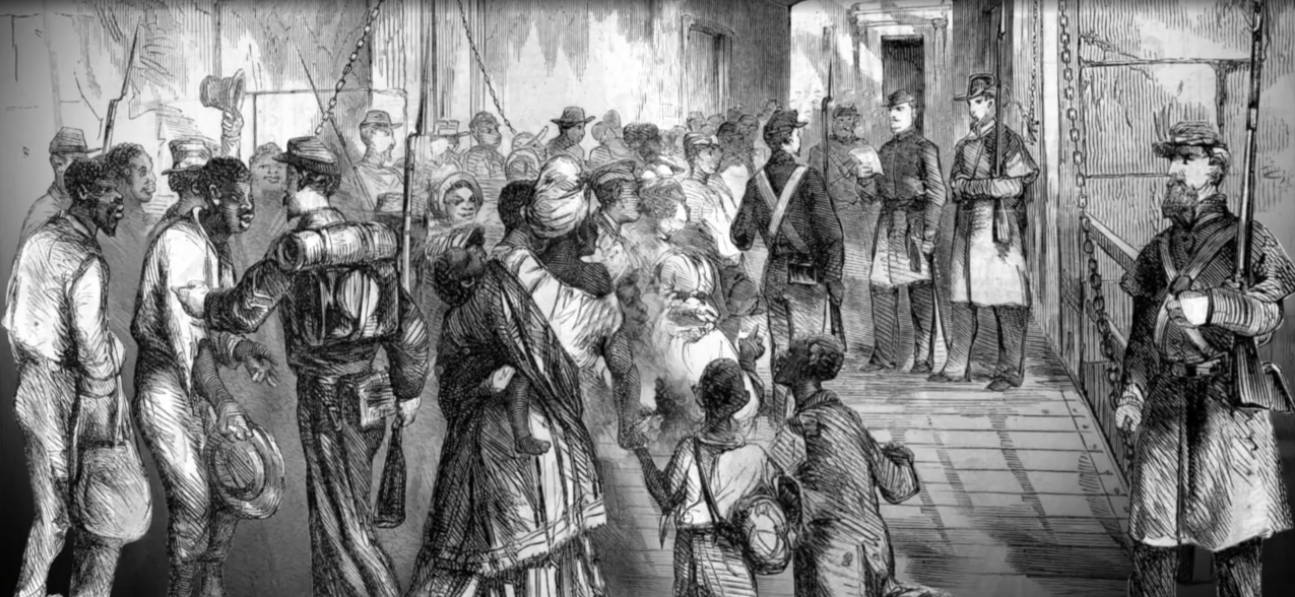
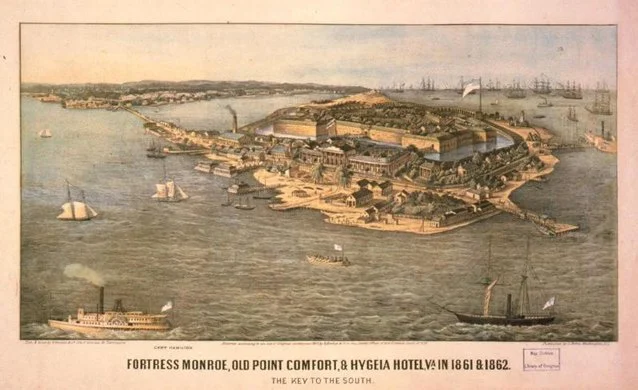
Learn from historian JOHN QUARSTEIN about Fort Monroe as “Freedom’s Fortress” which became a place of hope for thousands of enslaved people during the Civil War. In May 1861, three enslaved men, Frank Baker, James Townsend, and Shepard Mallory, escaped across the James River to Union-occupied Fort Monroe, challenging the legal status of fugitive slaves a day after Virginia seceded at the beginning of the Civil War. General Benjamin Butler refused to return them to their owner, designating them as "contraband of war", enemy property used to aid the Confederacy. This innovative landmark legal position sparked a mass of self-emancipating individuals. This presentation explores how the contraband policy shifted the war's purpose toward emancipation and led to numerous communities around Union forts and camps.

John V. Quarstein, award-winning Author, Historian, Educator, Preservationist, Speaker, and Director Emeritus of the USS Monitor Center at The Mariners' Museum and Park, in Newport News. John has received numerous awards for teaching, historic preservation, museum development and writing. His deep interest in all things related to the Civil War stems from his youth living on Fort Monroe, walking where heroes once stood.

View Event →
Smithfield Juneteenth Celebration - The Beginning of the End of Slavery in the USA
Jun
19
11:30 AM11:30

Smithfield Juneteenth Celebration - The Beginning of the End of Slavery in the USA

Beginning the day after Virginia seceded, at the beginning of the Civil War, enslaved people in Hampton Roads began liberating themselves by becoming “Contrabands”, escaping to Ft. Monroe and later at other Union forts and camps -- momentous first steps leading to Lincoln’s Emancipation Proclamation.

Aspects of this story are enacted by two members of the Contraband Historical Society, TONY GABRIELE as General Benjamin Butler and PHIL ADDERLEY as the Reverend William Roscoe Davis. Phil and Tony will then discuss the many ways the Society preserves this neglected history and brings it to the public.

View Event →
Daniel Parker Duvall - Descendant of Colonel Josiah Parker
May
9
2:00 PM14:00

Daniel Parker Duvall - Descendant of Colonel Josiah Parker

Josiah Parker was born on May 11, 1751 and raised at his family homestead in ‘Maccelsfield” on the James River in Isle of Wight County, Virginia. There and at Smithfield he lived with his wife Mary Pierce Bridger Parker, and their only child, Ann Pierce, and stepdaughters Judith and Catharine Bridger.

Daniel “Dan” Parker Duvall is the Great great grandson of Josiah Cowper Parker, in turn, he was one of four grandsons of Colonel Parker. Dan is a Parker family historian, researcher and author. Family coordinator of Ground Penetrating Radar(GPR) survey of Macclesfield Cemetery and Advocate for History and Education. He lives Pawleys Island, SC and is excited to share family histories in Isle of Wight County.

View Event →
The VIrginia State Navy and Isle of Wight County Mariners - YouTube Live
Apr
11
12:00 PM12:00

The VIrginia State Navy and Isle of Wight County Mariners - YouTube Live

Join Kent and Audrey for a YouTube live presentation on Virginia Boats and Local Mariners: During the American Revolutionary War, the Virginia State Navy—whose vessels were often called “Virginia Boats”—played a vital defensive role along the Chesapeake Bay and its tributaries, drawing heavily on the maritime skill of mariners from Isle of Wight County and the lower James River region. These locally built craft were typically shallow‑draft galleys, brigs, and armed schooners designed for Virginia’s narrow rivers and creeks, allowing them to maneuver where larger British warships could not.

Isle of Wight County sailors, experienced in coastal trade and river navigation, crewed these vessels and used their intimate knowledge of local waterways to protect commerce, convoy supplies, and harass British forces. Together, the Virginia Boats, their Captains and Crew exemplified how local shipbuilding traditions and adaptive naval technology supported revolutionary resistance on the water.

Maritime Historians Audrey and Kent Lewis are sailors, wooden‑boat builders and small‑boat restoration specialists whose work is dedicated to preserving and interpreting traditional small craft. As contributors to WoodenBoat magazine and Small Boats Nation, their historical research places small boats within their regional, economic, and social contexts, highlighting the often‑overlooked builders and mariners behind them. Audrey and Kent advocate for small wooden boats as forms of living history, that carry forward the sea stories of ancient mariners and their boats.

YouTube Live: @IWCVAHS

April 11, 12:00 PM EDT

View Event →
Jan
11
2:00 PM14:00

Chiricahua Apaches in Hampton Roads by W. Michael Farmer

  • 17140 Monument Circle Isle of Wight, VA, 23397 United States (map)
  • Google Calendar ICS

Synopsis

In September 1886, Geronimo, seventeen warriors, fourteen women, and six children surrendered to General Nelson A. Miles at Skeleton Canyon, Arizona. Geronimo and his band had been chased for five months across the southwestern United States and northern Mexico by 5,000 American soldiers, 3,000 Mexican soldiers, and hundreds of civilians. Not a single member of the band had been killed or captured when Geronimo surrendered. At the time of his surrender, Geronimo was the most feared and hated Indian in the United States. After Geronimo’s surrender, the army moved the entire Chiricahua tribe, nearly seven hundred men women and children, to Florida for two years and then to Mount Vernon Barracks, Alabama, for seven years. During their time in captivity at Mount Vernon, Hampton Roads nearly became the site for a reservation for Geronimo and the Chiricahua People. Throughout their years in captivity, a number of Chiricahua children were educated at the Hampton Institute. Lieutenant Charles B. Gatewood, who with two Apache scouts, an interpreter, and a mule packer risked his life to track down the Geronimo band in the Sierra Madre Mountains of Mexico to talk Geronimo into accepting surrender terms from General Miles. When the band accepted the terms, Gatewood helped shepherd the band past hostile Mexicans and Americans to surrender to General Miles. The army never recognized Gatewood for his phenomenal courage and work in bringing in Geronimo, giving the credit for “capturing” Geronimo to officers who had chased him for five months without success. Gatewood died at Fort Monroe, Hampton, Virginia, ten years after Geronimo surrendered. Hampton Roads has been a lot closer to the once wild and free Chiricahua Apaches than many realize.

About the Author

W. Michael Farmer combines over fifteen years of research into nineteenth-century Apache history and culture with Southwest-living experience to fill his stories with a genuine sense of time and place. A retired Ph.D. physicist, his scientific research included measurement of atmospheric aerosols with laser-based instruments. He published a two-volume reference book on atmospheric effects on remote sensing and award-winning short fiction in magazines and anthologies and nonfiction essays. His novels have won numerous awards including three Will Rogers Gold and five Silver Medallions, New Mexico-Arizona Book Awards for Adventure, Historical Fiction, Literary Fiction, a Non-Fiction New Mexico Book of the Year, and a Spur Finalist Award for Best First Novel. His book series includes The Life and Times of Yellow Boy, Mescalero Apache and Legends of the Desert, and seven books on the life and times of Geronimo.

View Event →
Dec
7
2:00 PM14:00

Annual Member Meeting & Presentation on Captain John Sinclair, 18th Century Patriot and Privateer

  • Isle of Wight County VA 1820s Clerk's Office (map)
  • Google Calendar ICS

Annual Member Meeting with a presentation on Captain John Sinclair by guest speaker Tom Wiatt, 4x Great Grandson of Captain Sinclair.

We will also tour the 1820s Clerk’s Office at the which is located next door to the Supervisor’s Board Room, at the modern day Isle of Wight County VA Courthouse Complex, .

Image credit: Boat US

View Event →
Sep
14
2:00 PM14:00

From Ironclads To Admiral: John Lorimer Worden and Naval Leadership

  • Benn's United Methodist Church (map)
  • Google Calendar ICS

Throughout his 52-year career, Rear Adm. John Lorimer Worden was always the right officer for the job. The epitome of an innovative commander who helped move the U.S. Navy out of the Age of Sail and into the era of steam/ironclad technology. Worden’s contributions extended far beyond his command of USS Monitor the Battle of Hampton Roads and influenced naval leadership for decades to follow.

The book, written by John V. Quarstein and Robert Worden, offers forth insightful details about the admiral’s career and his impact upon the Civil War’s ironclad revolution. Worden was much more than a combat leader as he served the navy as a scientific officer, executive officer, fleet commander, and educator with an innovative spirit and dedication to service which prompted many to say: “Let Worden Do It!”

Presented by John V. Quarstein is an award-winning Author, Historian, Educator, Preservationist, Speaker, and Director Emeritus of the USS Monitor Center at The Mariners' Museum and Park in Newport News, Virginia. John has received numerous awards for teaching, historic preservation, museum development and writing. John's deep interest in all things related to the Civil War stems from his youth living on Fort Monroe, walking where heroes like Abraham Lincoln and R. E. Lee once stood.

John will bring books to autograph and sell, an amazing opportunity to chat with the author.

View Event →
Jun
22
2:00 PM14:00

Isle of Wight County Records Project - The Records Tell the Story

  • Isle of Wight County Supervisors' Board Room (map)
  • Google Calendar ICS

Valerie Schmidt-Wilson became the Archivist and Conservator of Isle of Wight County historic court documents in the wake of the Family Search digitization efforts in 2012. Disturbed by the state that our documents were left in, Valerie began the ISLE OF WIGHT COUNTY RECORDS PROJECT. It was her mission to repair, preserve, organize and also learn about the old records our ancestors wrote, in a time forgotten.

When the local held loose paper was conserved and archived, County Clerk Sharon Jones reclaimed thousands of original documents from the Library of Virginia where they were held in a warehouse, completely inaccessible, and waiting to dissolve into dust. Thanks to Valerie’s design and implementation of the RECORDS PROJECT, those hidden papers are nearly all conserved, images of those amazing original documents are also now available to the public, and the original papers can be viewed by appointment.

Early in the RECORDS PROJECT, Valerie recognized the amazing information contained in many of those long-forgotten documents that were penned by our ancestors from the mid-1700s through the Civil War. The information, therein, tells a much fuller story about the early history of the county, and sheds very significant light on Valerie’s most passionate research project—the history of IOW County as it relates to the Tynes family, the house that Robert Tynes built in 1750, and the 1802 emancipation of 81 of Timothy Tynes’ slaves.

On Sunday June 22 at 2:00 pm Valerie will share some of the amazing things she has learned about the Tynes, the Old Brick House which she and her husband now own, the local population, and the famous emancipation of 81 Slaves in the 1802 WILL of Timothy Tynes. She will also talk about her growing, specifically documented database designed to help the descendants of the Black Tynes family in their quest to find their roots. 

View Event →
Jun
19
1:00 PM13:00

Four Paths to Freedom in the Early 1800s

Something must have been unique about the Southampton County community during the first half of the 19th Century. Four men of African descent, born just a few miles and years apart, took different paths to find freedom. The best known event, Nat Turner’s Rebellion, took the violent approach resulting in about 100 killed. The insurrection made the world recognize the harsh realities of enslavement; yet, brought stricter slave codes. Anthony Gardiner was able to ship passage to Liberia as part of the American Colonization Society. He prospered and later became president of Liberia. John Brown was sold away from his family into the Deep South. His enslaver’s cruelties prompted him to run away via the Underground Railroad. Once he reached safety in England, he published a boo about his experiences. This book was one of many that helped to spread the truth about the inequalities of slavery. Dred Scott was born in Southampton County about 1799. He moved west with his enslavers and eventually filed a suit for his freedom which resulted in the infamous 1857 Dred Scott Decision. Each of these stories are profound reflections by four men of African descent from Southampton County. They were all freedom fighters who helped guide the march toward emancipation.

Presented by John V. Quarstein is an award-winning Author, Historian, Educator, Preservationist, Speaker, and Director Emeritus of the USS Monitor Center at The Mariners' Museum and Park in Newport News, Virginia. John has received numerous awards for teaching, historic preservation, museum development and writing. John's deep interest in all things related to the Civil War stems from his youth living on Fort Monroe, walking where heroes like Abraham Lincoln and R. E. Lee once stood.

View Event →
John Rolfe by Richard Cheatham
Sep
15
2:00 PM14:00

John Rolfe by Richard Cheatham

  • Benn's United Methodist Church (map)
  • Google Calendar ICS

The Isle of Wight County and Surry County Historical Societies present "John Rolfe", portrayed by Richard A Cheatham, a 14th generation descendant. Richard is the founder and director of Living History Associates, a graduate of VMI, a school teacher, museum educator and TV reporter. John Rolfe was the pivotal early American who became the husband of Pocahontas. Their marriage at Jamestown brought an end to seven years of fighting between the native Powhatan people and the English. Rolfe was an entrepreneur who developed successful trade in tobacco, native plants blended with sweeter Spanish West Indies plants, that prevented the abandonment of the failing Virginia colony.

View Event →